Thursday, December 25, 2008

The saga of Indian Project Management

Evolution of a new PM generation in India
“The team is fully geared and motivate to commission the refinery ahead of its initial schedule of December 2008. RPL is thus poised to create a new world record for project implementation in the global refining sector,” - Mukesh Ambani (RPL chairman) New Delhi, 22-July -08
Today, 25-Dec-08 , Reliance Industries Limited (RIL) of India has announced that the ‘World’s BIGGEST Refinery’ at Gujarat , India, is all set to start on 28-Dec-08 on the birth anniversary of it’s founder chairman.
A remarkable project which attracted world attention for its size, complexity, low cost and above all project management excellence is getting completed.

Combined with the existing facility, the total production capacity of RIL-Jamnagar will be 1241000 barrels per day (bpd) which is 1.32 times bigger than the one next to it, which is Paraguana Refining Complex at Venezuela.
A Project Progress Report published by the company in 15-Jan-2008 indicated 82% completion, ahead of schedule in just 2 years since kick off! The Engineering efforts (Basic & Detailed Engineering) for this project were completed in less than 2 years which has set a global record in refining sector.
Completing a sophisticated project of this size in just 3 years is just incredible! All credits go to visionary management of RIL and dedicated PM professionals and labours at the Jamnagar site!
I would recommend you to visit this page in the reliance website which talks about “Innovation @ Reliance”
I think the black mark on Indian project managers caused due to severely mismanaged public sector projects, which were famous for over-runs and ‘never-ending’ behaviour, is an old story now. Cost effectiveness, speed of execution, technical expertise and quality are the trademarks of the new generation Indian PM’s.
Efficiency of Indian PM’s came to world’s attention only after the IT revolution. MNC’s employed Indian professionals at their development & research centres abroad in huge quantities. Every IT major has started facilities & operations in India, leveraging on the technical/managerial expertise and cost effectiveness. It is to be noted that much before the IT revolution, many large corporations in the US line NASA & IBM had employed Indian professionals in large numbers.
What Europe is for IT Project Managers, is Middle East for Industrial/Infrastructure Project managers from India. Millions of Indians work in various countries in infrastructure & industrial projects including thousands of Project Managers in various disciplines. The knowledge earned from international projects may help Indians to better PM practices in India.
Where Indian Project Managers are lacking?
(This section focus on Construction projects only. Project Management in service & IT sectors are much better organised in India)
From my personal experience I have found that Indian project professionals are hard working (Veterans of execution) but lack the following:

  1. Still many of the major projects lack proper ‘Formal’ planning
Project planning is still in its infancy in India. A preliminary schedule prepared in MS Project (or sometimes in MS Excel!) which hardly gets its update is all about the construction project management in many projects. Many senior officials in Project management sector don’t understand the formal planning concepts. S-Curve, Resource Histograms, cost baseline & EVM are just alien terms for them. There is always a hurry seen in starting execution before the formal planning is completed and performance measure & control systems are created. I heard many people saying “Erect the big structures and equipments first so that we can show some really nice early progress”. Effective sequencing of activities was often not done resulting re-work. Planners are not really respected and execution team always dominates and does not give proper inputs to Planning & Project control. Many people don’t understand the big truth that planning coordinates everyone’s efforts thus reduces duration and rework.
Shortage of ‘Trained’ professionals in Project Management are the reason for sidelining the planning function in Indian Project Management Scenario.

  1. Documentation is not up to international standards
One of the major characteristic of international projects is extensive and comprehensive documentation. Projects documents can generally be classified as:
    1. Technical / Engineering documents
    2. Quality documentation
    3. Planning & general project management documents
    4. Procurement & finance/Cost related documents
    5. Project communication
 In Indian industrial projects, ‘a’ and‘d’ are found to be maintained reasonably well. How ever the remaining 3 types of documents ( ‘b’,’c’ and ‘e’) are not really maintained well!
A properly documented project ensures smooth execution and helps the project team by functioning itself as a guide for future projects

  1. Safety is not meeting international benchmarks
 Safety is talked every where unlike olden days where execution was the only concern for construction professionals. How ever safety standards in Indian construction projects, especially civil, are far below international benchmarks. In one of the large projects which I have worked, the civil contractor ruled out usage of safety shoes for civil labour saying that ‘Rural labour force used were not comfortable in wearing heavy safety shoes and denied repeated instructions for usage of the same” They used low quality slippers and helmets made of recycled plastic ! Attempts for strict implementation of proper PPE on them drastically reduced project progress and at a critical stage, the site management team relaxed the PPE norms for the civil construction team!
Scaffolding, scissor lifts and even proper ladders are still ‘Luxury’ for Indian construction. A standard Indian supervisor will encourage the worker to perform a “Ripley's believe it or not” act if a proper safe working way is ‘too costly”. There are lots of ‘Safety Training Institutes’ mushrooming in India. How ever none of these professionals can find a job market with in India.

  1. No formal project closing
I was not fortunate to see a formal project closing in India which is limited maximum to a cocktail party in the nearby hotel! We don’t have to search for another reason for repeated over-runs in schedule & cost projects after projects.
I would like to quote a catching line for the Relience website "First time it is learning. Second time it is a mistake." – and it explains all !
  
 But Why ?
     The answer is money!
  • Projects in India are executed in tight budget
  • Salaries of PM & construction professionals are relatively low
  • Lack of trained PM professionals in construction filed 
The third point can be related to the second one since, many of the educated and trained professionals opt of jobs abroad which give better financial benefits. Apart form this, basic change of mindset is to be done, which focus on only 1 (Execution) and nearly ignores /dilutes rest of the 4 Project management process groups (Initiation, Planning, Monitoring & Control and Closing).

Where to look for examples?
I feel British are the people who respects planners most! I was amazed to experience this myself.
Indian PM’s can learn a lot form the commitment and importance which British PM’s give to planning, systems, quality and safety.
Americans focus greatly on cost control. NASA has set lots of standards for Project & Programme management. PMI, a US based Project Management organization is considered as the largest project management organisation in the world.
Japanese are real hard workers and focus greatly on productivity. They are not less than anyone in creativity or innovation also.

Final thoughts
Indians possess a right blend of hard work and intelligence. If the raw talent, which is abundant, subjected to formal training (by those who are experienced from international projects) can do wonders for the PM scenario in India. Recent establishment of an Indian subsidiary of PMI (the one & only wholly owned subsidiary of PMI USA) in New Delhi can be seen as the realisation of PM potential of India.
Industrial production decides the progress & wealth of the nation.
Well executed projects (schedule, cost, quality & safety) will have serious positive impact on Indian economic scenario. In the age of recession, ‘effectiveness’ and ‘efficiency’ matters lot!

Links

Wednesday, December 3, 2008

Construction slowdown amid global financial crisis

The second half of 2008 was not very pleasing. Global financial crisis & terror attacks are undoubtedly the highlights of the second half of 2008. Biggest names in financial sector fell in just few days and it did spread the panic in the construction industry as well. Financial institutions put a break on lending and started cutting jobs as a primary step to reduce operating costs. Many other industries followed (or misused) the trend from financial institutions and started cost cutting initiatives including axing of jobs.
It is a fact that global funding has been reduced. How ever there is a wide spread opinion that the ‘Crisis’ is over hyped.
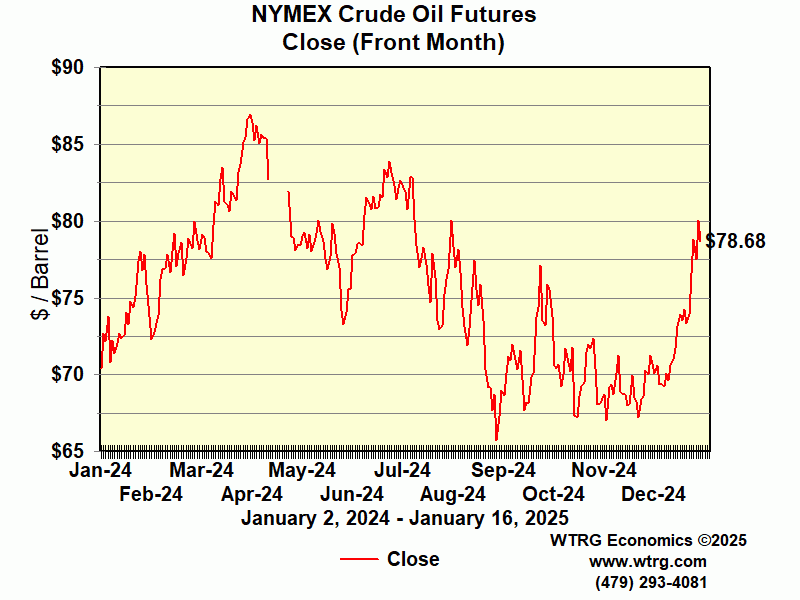
It wont be an exaggeration, if I say Middle East is the ‘Construction Capital’ of the world (at the moment) ! The only way this region can be affected financially, is fall of oil prices.
Credit :  http://www.wtrg.com/daily/clfclose.gif
The above graph shows heavy drop in oil prices by atleast 65% , which directly axes the revenue of GCC countries by 65% !
Many of the leading construction companies and clients are state owned and hence the effect of this drop is clearly visible in Middle east projects.
Go through the following news articles in “ArabianBusiness.com ” , which emphasise this fact.
“Dubai-owned real estate developer Nakheel is delaying several of its flagship projects, including the Trump International Hotel and Tower, in addition to axing 500 jobs amid the global financial crisis, the company said late on Sunday.”
“Azizi Investments, one of the Gulf’s fastest growing real estate developers, has announced it will not launch any new development projects in light of the global economic crisis.
The company's announcement follows news that Palm developer Nakheel was also considering scaling down some of its projects as the global economic downturn continues.”
 “Travel has become more localised within the Middle East and North Africa (MENA) region and there is a shift away from business class use, as travellers respond to fears of a recession, according to YouGovSiraj's latest travel tracker.”
 Another indicator of recession is house rent & property rates. Most of the Middle East magazines and news papers have reported downward trend in demand of properties and housing rent rates.
Steel import price can be seen an important index of the “demand” from the construction industry. The following graph from “ME-Steel.com ” speaks by itself :
It is noteworthy that the steel prices has come down by almost 50% in just 4 months!
I don’t think the slow down in the construction industry stay for long term, especially in Middle East, since this region is in the development phase. Countries like UAE have been seen developing fast to the living standards of rich European countries, in the past. To keep the pace of this development, they surely have to go ahead with infrastructure & industrial projects.
And, now, thatz a good news for project management professionals in the Middle East region!


Thursday, November 20, 2008

The Battle of Standards

The latest news in PM circle (Especially those who aim at PMP certification) is about the new Body of Knowledge (BOK) from Project Management Institute (PMI) scheduled to release in December 2008. PMI has already published the key changes in the new standard – PMBOK® Guide 4th Edition. You may find the link here . (Thank you Rich for the link!). One of the major changes which I have noticed is the change in the process nomenclature to ‘Verb-Noun’ format. Even though there won’t be drastic changes in the PMP exam pattern, I expect many people to stay away from applying for certification during the transition period. People may consider preparing for the PMP based on latest standard (4th edition) , so that it will help in re-examinations if any one fail to make it in the first attempt.
More over, PMP exam goes wery much with terminologies and hence candidates may have a fear of getting confused with outdated terminology (if any) in case if they need to study the new standard while re-appearing.
Standards are to be revised to keep them aligned with the technological and conceptual changes happening in the industry from time to time. How ever, existence of many standards for the same purpose sometimes makes practitioners life difficult. (Especially who are working with international projects). For mechanical items we have already British, American and Dutch standards(BS-IS, DN, API, ANSI..etc) . I think ISO has succeeded to great extent in uniting various standards and arriving with widely accepted standards. The best examples are ISO 9001, ISO 14001 and OHSAS 18001. I have involved in Quality certifications in present and previous employments and recently got certified from Bureau Veritas (Certified Internal Auditor for Integrated Management System). All these standards and the audits associated with them go behind the ‘Standard Terminologies’ and ‘Methods’ to great extent.
Back to Project Management standards. BSI has got BS-6079-1-2002 , as the standard for Project Management. I have read it a couple of times and found it as very much lighter than PMI’s PMBOK® 3rd Edition(PMBOK is ANSI/PMI 99-001-2004). PMI has taken very extensive approach (may be because they are focused on PM only) than BSI in the development of the standards. There were no revisions to BS 6079 after 2002 , how ever PMI has released 3rd edition to PMBOK in 2004 and kept the pace of up gradation steady by conducting several studies, research work and discussions. They have now come up with PMBOK® 4th Edition, which they claim to “ reflect the evolving knowledge within the profession of project management”.
It was a year back; ISO has announced commencement of the work on a new international standard for Project Management (ISO 21500). BSI released a new letter in this regard (read it here), which claim ISO 21500 as an extension of BS-6079-1-2002. How ever in the ISO news letter regarding the same subject (read it here) there is no mention about BS-6079, other than a mention of BSI, who was the host to the kick off ceremony (held in London).
I am not aware about the involvement/contribution of PMI in the development of ISO 21500 (My search for ISO 21500 in the PMI website returned no results! ) I would like to hear from anyone who knows about this.
I have checked for the cross reference of the BS, PMI & ISO standards in their respective websites and the following are the results:


I hope ISO 21500 is expected to release some where in 2010. 
The following powerpoint presentation gives a good insight into the release and contents of ISO 21500. 
Take a look at the possible structure of ISO 21500, as per the above mentioned presentation:
PMBOK® 3rd Edition, focus on 5 key processes in 9 Knowledge areas.
  • 5 Project Management Process Groups
  • 9 Knowledge Areas
  • 44 project management processes
  
How many standards do we need?
Well my answer is ‘One’. Standard stands for ‘standardisation’ or ‘uniformity’. Now world is like a global village. People are working in multi ethnic – multi national teams. A project happening some where in middle east can have a German consultant working for a British client employing an American contractor. Project Management itself is an evolving profession and any one can say undoubtedly that PMI has played the main role in bringing up identity for that. The certifications, standards and marketing initiatives by PMI have made project management, a widely discussed and distinguished topic.
A new ISO standard for Project Management is always welcome, but it shall absorb all the good features of PMI & BS standards. I hope the standard committees are working in a collaborative way and we can expect release of ‘ONE’ standard, which is accepted by all PM organisations and PM practitioners across the world by the end of first decade of this millennium.
By the way, I am already sitting cross legged to watch the new PMBOK 4th edition and kept my desk ready to keep a copy of ISO 21500!!

Links:
  1. http://www.bsi-global.com/en/About-BSI/News-Room/BSI-News-Content/Disciplines/Risk-Management/Project-Management-/
  2. http://www.iso.org/iso/pressrelease.htm?refid=Ref1092
  3. http://www.ansi.org/news_publications/news_story.aspx?menuid=7&articleid=1664

Sunday, November 16, 2008

Ancient project management

Any one who is on tour to historical monuments, old temples, churches and palaces wonder how those were built during a period when construction machineries, computer and communication devices were not available. I have wondered every time I visited thousands of year old temples in India how they were built during those days. Beautifully carved single stone structures, each weighing several tonnes placed at enormous heights. There is no way they can be built with out precise planning and execution. Because they are sophisticated by their construction and the locations where they built are challenging.
I have searched a lot to find a piece of graphic which illustrates the planning done on any of such great projects. But sadly I couldn’t find any! When history of project management can’t look beyond 1900, what is the purpose of searching for PM documents dated several thousands of years back!
Construction of some of the outstanding historical structures like The Great Pyramid of Giza) is believed to be employed several lakhs(1,00,000) of people. There were extensive studies on the methodologies used for construction (in the absence of machineries) , especially on Egyptian Pyramids. How ever I couldn’t find any research on the project management and labour co-ordination techniques used. A video on ‘Construction of Persepolis’ (built 2500 years back, known as the richest city under the sun !) in ancient Iran indicate that there was proper construction organisation with titles similar to managers and supervisors. Archaeologists have recovered proofs indicating wage system for labourers. Giza Pyramid construction workers were believed to be lived near the construction sites in so called ‘Labour camps’.
When archaeologists & scientists are working hard to reveal the technologies (and techniques) used in these ancient ‘Great Projects’ , no one seem to be working on the project management and planning perspective of these jobs.
All the results of my searches related to project management constrained to 19th century. Does this imply that no project management and planning techniques were used in all those magnificent projects which may be extremely challenging even if executed these days?
Well, the socio-economic conditions prevailed in those days were different form today. Most of the ancient great projects were result of an instruction from the ruling King. The most skilled crafts man was chosen to take care of the construction and it was his responsibility to recruit best talent to work under him. Messengers were sent to each village to reach the message of the new project and great crafts men reported the King or his designated Master craftsman.
  •  Motivation? Fear or respect to the King or a mix of both! [Build it , or you are killed ! – haa haa]
  • Fund ? Unlimited funding from the King’s treasure!
  • Quality ? The king won’t compromise for a low grade product! – So best of its kind!
  • Schedule? Yep , there would have been , because the King want to see the result before he dies and probably he want to enjoy the fame of the great creation for as long as it can be !
Some records show details of labour allocation into gangs. An ancient version of Organogram !
Check out the crew allocation diagram for ‘Giza Pyamid Construction Project’:

But how they managed the big picture? Those were not random creations or activities. Coordinated efforts/activities to achieve a well defined outcome. Look at the magnificence and symmetry of great old temples in India! It is evident that a lot of planning and activity sequencing might have taken place. But how they did those? No one knows!
Most of such temples possess the following characteristics:
  • Challenging locations
  • Enormous sizes
  • Overall symmetry in site installations
  • Symmetry in individual structures
  • Minute art works in elements of individual structures

Indian art generally seems to focus on symmetry and detailing. The same reflects on old constructions as well. More over ancient artists/crafts men are fathers of modern engineers! Even renaissance engineers like Da Vinci and Michael Angelo were outstanding artists also apart from being engineers and inventors.
The reason for the non availability of the details of execution of these projects can be:
  • Educated upper society was only interested in the beauty and magnificence of the structures. In short the focus was on design & architecture and not in the methodology of construction.
  • Execution was the responsibility of craftsmen who were generally uneducated.
  • Secrecy: Several techniques were kept as secret among certain ‘Gothras’ or tribes who were specialised in crafts. These techniques were only transmitted from one generation to the next of the same ‘Gothra’
  • It is also debated that rulers kill the creators/crew of great structures once it is completed so that similar kind is not built again (How ever , this is not a proven fact!)
It will be great , if premier PM organizations like PMI take up some research projects on ‘Ancient Project Management’ and extend the history of PM beyond 19th century. It may also bring out some theories which can contribute to modern project management.
 If you have few more moments to spare, just have a look at these outstanding ancient projects. I also recommend you to visit the external links provided at the end of this article.
You may find that ancient Hindu temples tops all the great constructions in terms of beauty , attention to details and sophistication!

 208 BC The first major construction of the Great Wall of China, circa 221-206 BC

 The Colosseum

The Taj Mahal , India 1631-1654

The Hanging Gardens of Babylon

 The Mausoleum at Halicarnassus
 The Temple of Artemis at Ephesus

Persepolis

Lighthouse of Alexandria

Stonehenge in England, built in several stages from 2800 - 1800 BC

 Petra, the rock-carved city in Jordan, 6th century BC

Parthenon in Athens, Greece, 477 to 438  BC 

  Mayan Temples at Tikal, 700-900

Angkor Wat in Cambodia, 1113-1150

 Cathedral of Chartres, France 1194 to 1260

Machu Picchu, Inca city in Peru, circa 1400s

 Madurai Meenakshi temple, India

 Khajuraho Temple, India

Sun Temple, Konark, Orissa- India
 Prambanan Temple, Indonesia

Nanjundeswara Temple, Mysore, India

Somnatha Temple, Karnataka, India
Links:

http://www.fsteiger.com/

Tuesday, November 11, 2008

PM Karma Community

Dear fellow PM bloggers !
  It is my greatest pleasure to roll out the 'PM Karma' community. It is aimed at forming a friendly and collaborative group of PM enthusiasts who share our knowledge and contribute to each other's professional growth. Basically this will be a group of PM bloggers , who are linked to me (and linked by me). We will  be actively discussing on the topics of our interest (which we publish through our blogs). Effectively , this will increase the traffic and visibility of our blogs and will also help us to know each other more. This will help us to share information, help each other in making our jobs better (or a better job !).
How to join PM Karma Community (PMKC):
Its' easy , just comment below this post & I will add you to the community. Please provide the following info as well:
  1. Your full name
  2. Your profile link
  3. Your blog / web address
You are also requested to provide a link in your blog to mine (How ever this is not a mandatory requirement to join the community. But it is highly recommended since we will keep informed about each others postings, thus keeping our community closely connected)
Where can I find the community members?
I will add a member page , after receiving sufficient number of requests.
What about adding a thumbnail of member? Please let me know.
Rules?
  1. Keep your blog clean (You know what I mean!)
  2. No abusive comments
Note:
Also read about the 'Link Exchange Initiative' here 
(PM Karma Community is an extension of PM Karma Link Exchange Initiative )

Welcome to PM Karma Community !

Thanks & Regards,

Sreejith